When I was just starting out in my career, living alone in my first apartment in downtown Sacramento, I would walk down to the nearby café called Java City in the evening after dinner. There I would sit with my journal, writing and watching people. I would socialize with friends who would stop by my table, or I would quietly read or write, happy to be among the activity.
That café is what people now call a third place: an alternative to home or the workplace. Think coffee shops, bookstores, salons, bars, libraries, social clubs and community centers. Third places are anywhere where you and your friends can hang out, shoot the breeze. No agenda. No stated purpose. No structured and earnest attempt of “meaningful conversation.”
Lisbon has resurrected its distinctive third places — the neighborhood kiosks (quiosque). Built in the 19th century, these historic structures serve beer, wine, and snacks. There are 25 of them throughout Lisbon. They were largely shuttered during the 50-year dictatorship, since public gatherings were strictly frowned upon.
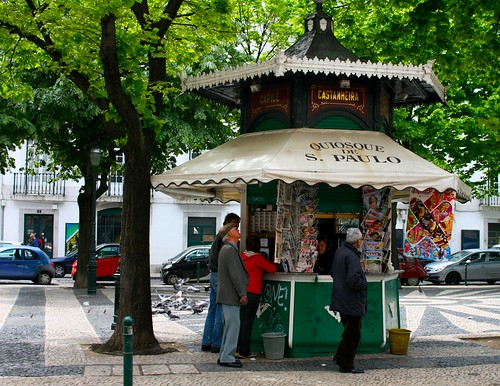
I can’t help but wonder if today’s culture of isolation – everyone driving their own car, sitting at home scrolling — may not be some kind of move to keep people from getting together and sharing (dangerous) ideas.
Unfortunately, even in Lisbon, those casual, inexpensive spots for just sitting and killing time are threatened.
In the center of Lisbon stands Jardim de Estrela, a lush city block that features trees, lawns, and duck ponds. Built in 1852, it has been a green respite in the center of a busy urban area. For years, a klatch of older gentlemen would gather at a few tables in front of a small café and play cards. A few of them would stand around observing the proceedings. I looked upon this as evidence of maintaining social connections — one of the principles behind the so-called Blue Zones, which contribute to healthy aging.
Last year, that run-down café was redesigned and re-opened as an upscale diner. Young, urban, stylish, and mostly foreign socialites occupy the space there, chowing down on brunches of smoked salmon-avocado toast and matcha chai. The gentlemen and their lazy afternoon card games are gone.
Over the years I have seen the steady decline of the Portuguese cafes, where the old-timers from the neighborhood would sit together and run commentary on whatever news was on the ubiquitous television on the wall. Those spots have been replaced by natural wine bars and Scandinavian — then Japanese — third-wave coffee houses.
Now getting together with a friend requires half a dozen back and forth texts and the kind of coordination the military would envy. Every experience must be curated, then documented. Even a simple phone call to catch up with a friend requires being booked days in advance like a board meeting.
I miss afternoons of running errands with a friend, then lounging around a park for the afternoon doing nothing but talking without an objective or a schedule. Or lazy Sunday mornings at a diner, drinking coffee and eating bagels, thick newspapers spread over multiple tables as we read everything from the opinion pages to the funnies.
These days I still walk down to Jardim de Estrela, not to accomplish anything — just to sit at the other, non-fancy kiosk that is still here and let the afternoon happen around me. Often I spot a friend walking by and we have an energetic, impromptu chat. The kiosks survived a dictatorship. I have to believe they can survive brunch.